Two summers ago, I watched a guy two doors down paint his entire house the wrong color.
Not wrong like he picked something ugly. Wrong like he picked a shade that looked gorgeous on the little card at Sherwin-Williams and turned into a weird, sad gray-pink the second it hit his siding. He figured it out about four hours in. His ladder was already up, half the front was done, and his wife was standing in the driveway with her arms crossed. Too late. He lived with it for three years.
That’s the entire argument for exterior paint samples in one paragraph. Everything below is just details.
Your Exterior Paint Sample chip is lying to you.
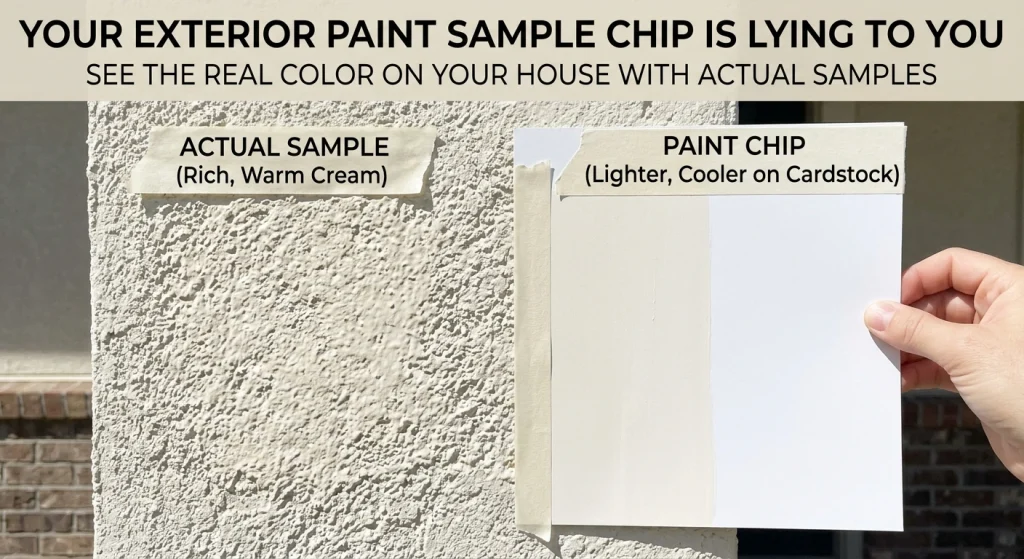
Paint chips are printed on bright white cardstock. That white background bounces light back through the paint film, which makes every color read lighter and cooler than it will on your house. Interior designers have been griping about this for decades for exterior paint sample.
And your house isn’t a flat piece of paper. Wood siding soaks up light. Stucco throws it around. Brick eats it alive. A color that looks soft and creamy on a chip can go muddy or harsh on real siding, and you won’t know until it’s up there.
So no, chips don’t count. You need actual samples.
How to test exterior paint colors (the four methods that work)

There’s no shortage of advice on this. Most of it is fine. Here’s what’s actually worked for me, ranked.
Peel-and-stick swatches: Samplize and a couple of other companies sell 12-inch vinyl squares printed with real paint film. Stick one on your siding, leave it for a few days, move it around the house. Five to eight bucks each. Zero mess, zero commitment. I’ve used these on three houses, and they have never steered me wrong.
Foamcore boards: This is what old-school painters do, and there’s a reason. Paint a 4×4 board with two coats, let it cure, then carry it around the house like you’re showing off a new puppy. Hold it against the trim. Hold it under the eaves. Hold it next to the roof. Watch it change.
Exterior Paint Sample: The final exam. Once you’re down to two colors, buy actual sample pots in your actual finish. Paint a two-foot square somewhere nobody will notice. Two coats. Wait a day. Look again.
AI visualizers: FacadeColorizer, the Sherwin-Williams tool, that whole category. Genuinely useful for cutting twenty colors down to five in ten minutes. Just don’t order paint off a screen. Your phone’s color calibration is a joke, and your screen has no idea what your roof looks like at 4 p.m.
The undertones will betray you.
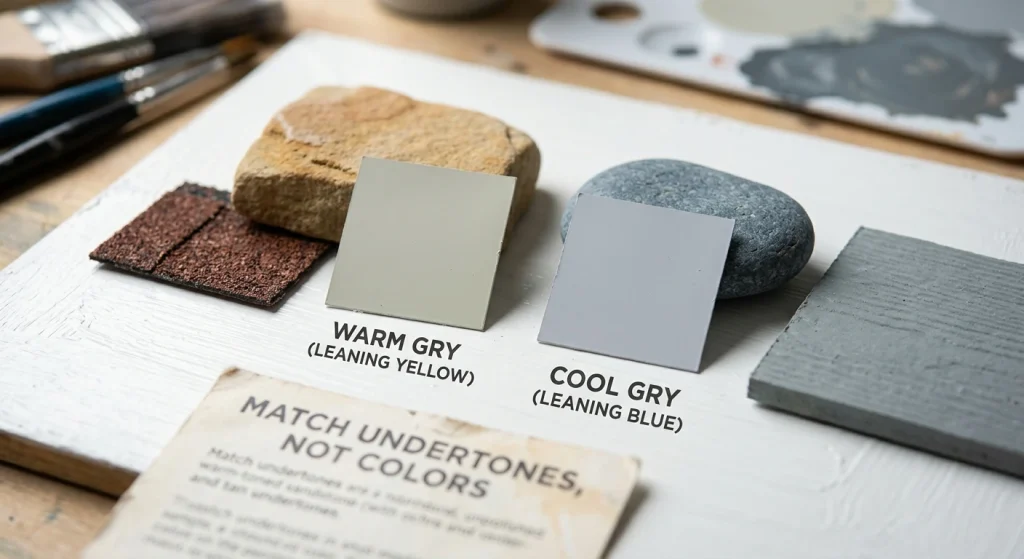
This is the part that catches even careful people, so pay attention.
Every color has an undertone, the hidden hue sitting underneath the one you think you’re looking at. Warm undertones lean yellow, red, or orange. Cool ones lean blue, green, or violet. You don’t notice undertones on a chip. You notice them on a whole house.
Here’s why it matters. Your roof, your driveway, your stone veneer, your neighbor’s brick they all have undertones too. Put cool gray siding next to a warm brown roof, and both of them start looking wrong. The gray turns dingy. The roof turns orange. Neither color is bad. They hate each other.
My rule: match undertones, not colors. If your roof is warm, lean warm on the siding. If your stone is cool, stay cool. Sounds obvious when you say it out loud. Nobody does it.
The lighting thing nobody warns you about
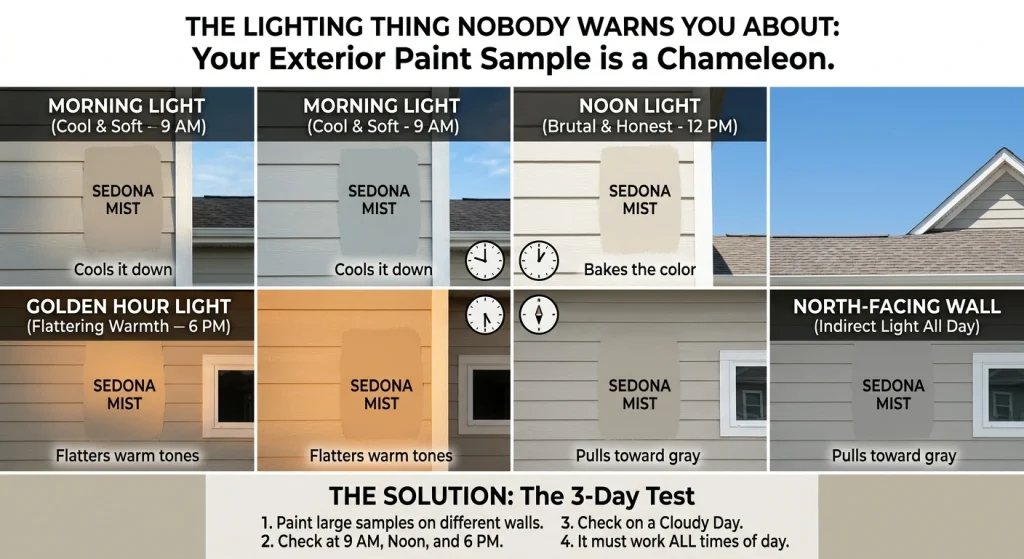
The same exterior paint sample will look like three different colors depending on when you look at it. Morning light is cool and soft. Noon is brutal and honest. Golden hour flatters warm tones and turns cool ones moody and dark.
North-facing walls get indirect light all day and pull everything toward gray. South-facing walls get baked and read warmer and brighter than you expect. If your house has both, and most do, you’re essentially choosing two colors at once.
My routine: leave samples up for at least three days. Check them at 9 a.m., noon, and 6 p.m. Check them on a cloudy day too. If a color only works at one time of day, it doesn’t work.
Mistakes I’ve made so you don’t have to
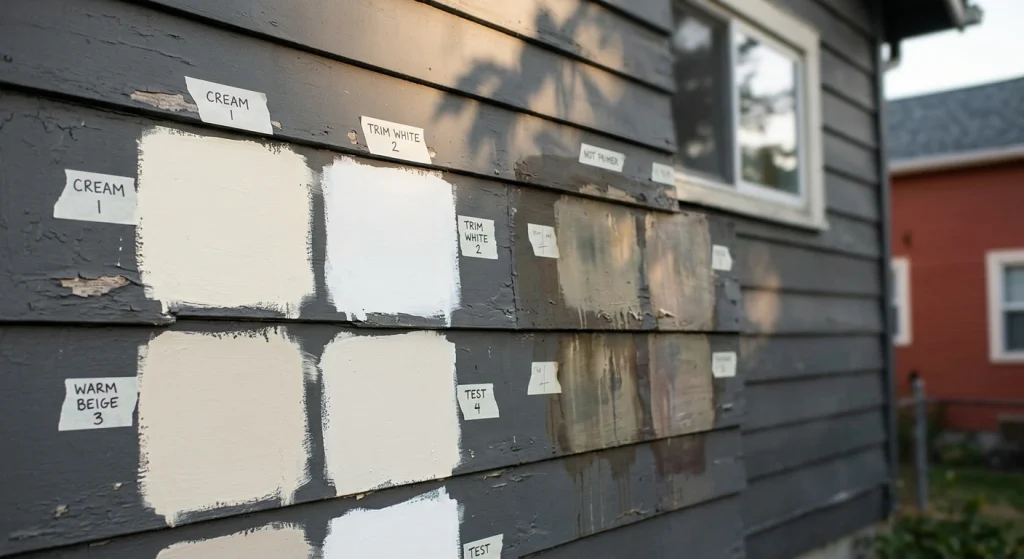
I tested siding colors once and completely forgot about the trim. Picked a warm cream that looked perfect, paired it with stark white trim, and suddenly my house looked like a lemon. Paint the trim color next to the siding color on the same board. Always.
Second mistake: testing over existing dark paint without priming. The old color bled through and made everything read two shades darker. Wasted a week.
Third: I ignored the fact that my house faces north. Everything I loved looked cold and gray in person. Took me embarrassingly long to connect the dots.
Fourth, and this one cost me real money: I tested in October and painted in July. Same color, same can, completely different result. Sun angle changes everything between seasons. If you’re sampling in fall, expect the color to look noticeably brighter and warmer by midsummer.
And look, this one’s petty, but check your neighbors’ houses before you commit. If the guy across the street just painted his front door fire-engine red, maybe shelve the bold orange you were considering. Your house doesn’t exist in a vacuum. If you’ve got an HOA, read the approved palette before you fall in love with anything. Nothing hurts like loving a color you’re not allowed to use.
What’s actually trending in 2026

The all-white farmhouse thing is finally loosening its grip. Warmer is back. Creamy neutrals, soft greens, dusty pinks, warm grays, taupe.
Beige especially; it’s jumped to roughly a quarter of renovated exteriors, more than double where it sat two years ago. Earthy greens are climbing too.
Do you have to care? No. Classic white with black accents will still look sharp in 2040. But if you want the place to feel current without chasing a trend, warm and earthy beats another icy gray.
Quick FAQ
How many samples should I test?
Ten chips, four peel-and-sticks, two pints. That’s the funnel. Don’t test thirty colors; you’ll confuse yourself and end up picking the one you saw first anyway.
Are peel-and-stick samples accurate?
The good ones are, yes. Real paint film, not ink. Not a perfect substitute for a sample pint, but close enough to narrow it down.
Does sheen matter?
More than people think. Flat hides imperfections and looks richer. Satin cleans easier and reflects more light, which can brighten a color by a full shade. Test in the sheen you’re actually buying.
Can I test in winter?
Peel-and-sticks, sure. Actual paint needs temps above 50°F to cure, so save the sample pints for spring unless you’re painting boards indoors.
How much does this all cost?
Thirty to fifty bucks for a full round of samples. Compare that to $4,000 or more for a repaint. It’s the cheapest insurance in home improvement.
Last thing
Nobody regrets spending forty bucks on exterior paint samples. Plenty of people regret spending $4,000 repainting a house they hate.
Get the samples. Leave them up for three days. Look at them at three different times of day. Check the undertones against your roof before you fall in love. That’s the whole secret, and it hasn’t changed in thirty years.
Ready to stop guessing? Grab a few of the best exterior paint samples from our shop and get them on your siding this week. Your future self, your driveway, and your neighbors will thank you.
For more information and inspirations visit Paint Pallete Inspirations.