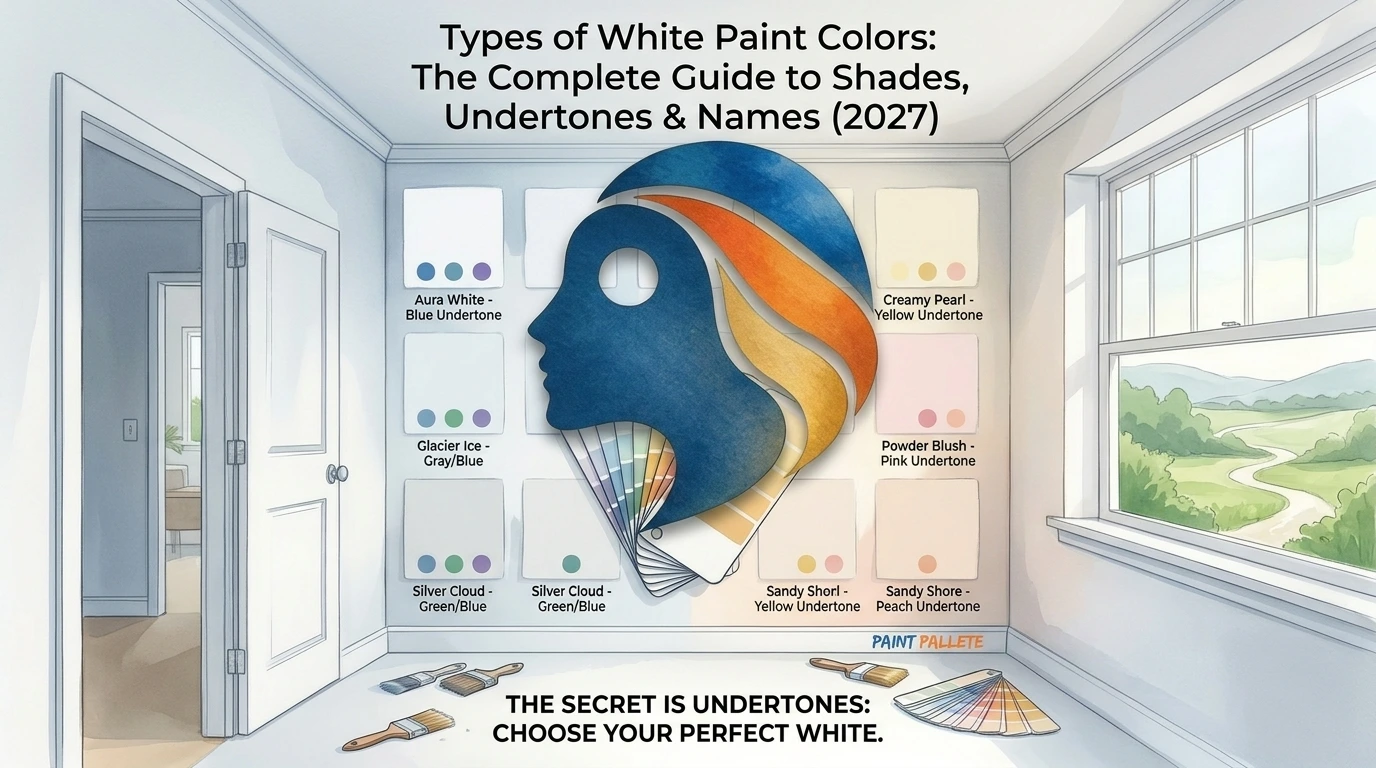

Stand in front of a white paint display and something strange happens. Every fan deck looks identical. You pick one, get it home, and suddenly your wall is yellow. Or blue. Or vaguely gray in a way you can’t quite explain to your partner.
That’s not bad luck. It’s undertone, and it’s the whole game with white paint.
Here’s a breakdown of the white paint shades you’ll actually find on the shelf, what sets them apart, and the names worth jotting down before you head to the store.
First, What Actually Makes a White a “Type”?
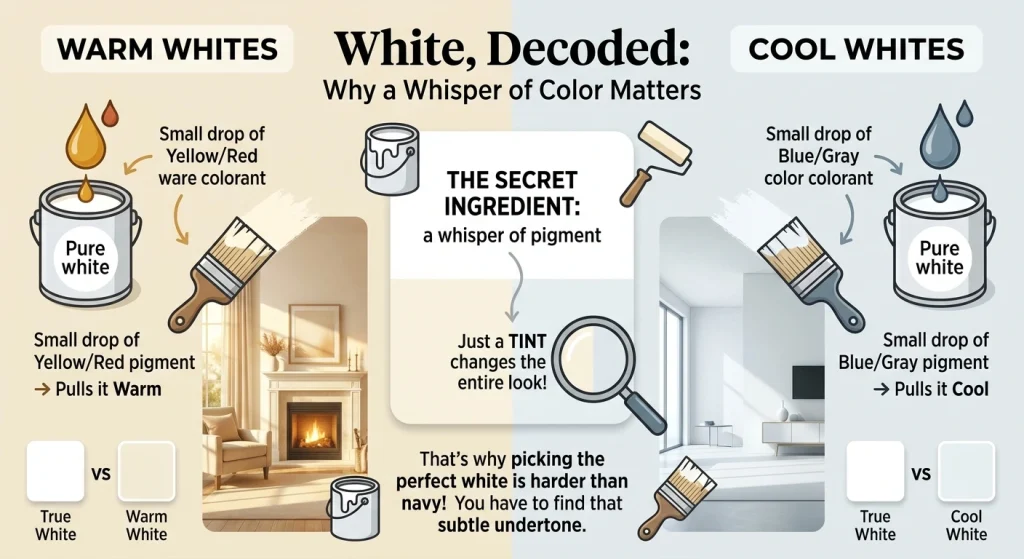
Short answer: a whisper of pigment.
Paint companies start with a white base and add a tiny amount of colorant. Yellow, red, or peach pushes it warm. Blue, green, or gray pulls it cool. Almost nothing added leaves it true. That’s it. That’s the entire difference between two swatches that look like twins in the store and strangers on your wall.
That is exactly why white is harder to pick than navy. With navy, at least you know what you’re getting.
Warm White Paint Colors

Warm whites carry yellow, cream, or peachy undertones. They feel soft and lived-in rather than sharp. The kind of white that makes a room feel like someone actually lives there.
They’re brilliant in rooms that don’t get much sun, especially north-facing ones. Cool daylight plus cool white equals gray and slightly sad. Warm white fixes that fast.
Shade names people ask for:
- Dulux Antique White U.S.A: the safe, timeless pick
- Dulux Whisper White: soft and calm, great for bedrooms
- Benjamin Moore White Dove: creamy without tipping yellow
- Sherwin-Williams Alabaster: a forgiving warm neutral, around 82 LRV
One catch: Put a warm white in a sun-drenched south-facing room, and it can start reading cream. Sometimes that’s gorgeous. Sometimes it isn’t.
Cool White Paint Colors
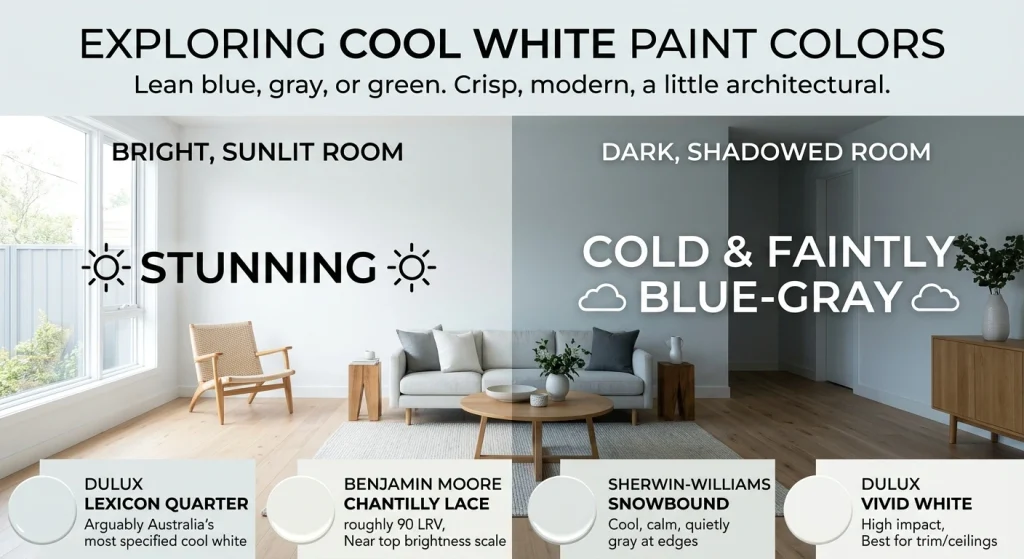
Cool whites lean blue, gray, or green. Crisp, modern, a little architectural. In a bright room, they’re stunning. In a dark room, they can read as cold and faintly blue-gray.
Shade names people ask for:
- Dulux Lexicon Quarter: arguably Australia’s most specified cool white
- Benjamin Moore Chantilly Lace: roughly 90 LRV, near the top of the brightness scale
- Sherwin-Williams Snowbound: cool, calm, quietly gray at the edges
- Dulux Vivid White: high impact, best saved for trim and ceilings
Neutral White Paint Colors

The Goldilocks group. Not too warm, not too cool, subtle enough to sit quietly next to timber, stone, and basically any furniture you own.
If you’re paralyzed by choice and most people start here.
Shade names people ask for:
- Dulux Natural White: the default neutral in thousands of homes
- Dulux Casper White Quarter: soft, modern, beautiful with stone
- Sherwin-Williams Pure White: flexible across different lighting
True White Paint Colors
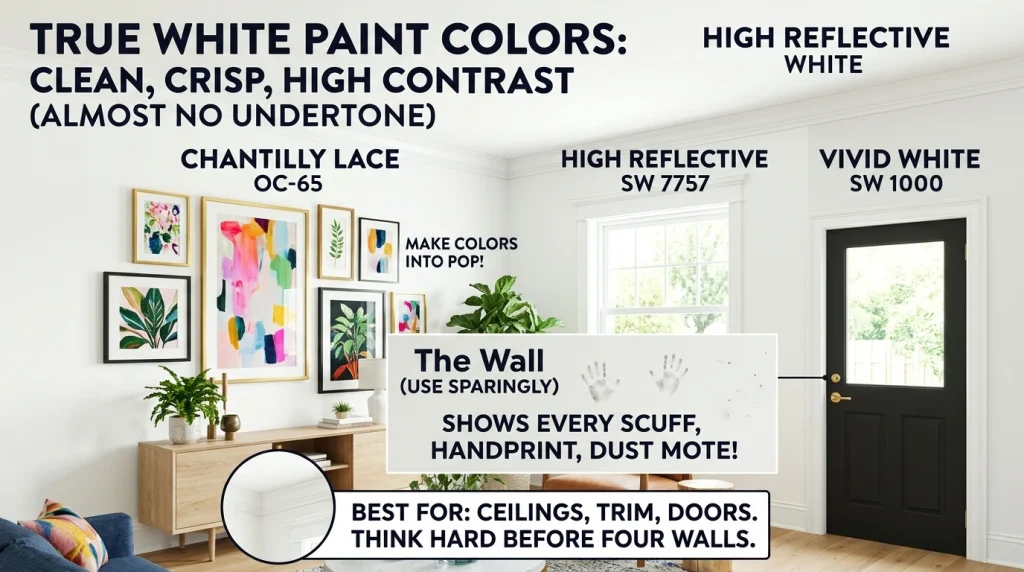
True white has almost no undertone. Clean, crisp, high contrast. It makes art and trim pop.
Here’s my unpopular opinion: painting a whole room in true white is the most common mistake I see. It photographs beautifully and lives terribly. Every scuff, handprint, and dust mote shows up like a headline. Use it on ceilings, trim, and doors. Think hard before rolling it across four walls.
Shade names people ask for:
- Benjamin Moore Chantilly Lace
- Sherwin-Williams High Reflective White
- Dulux Vivid White
Off-White Paint Colors

Off-whites sit just outside the family ivory, bone, linen, alabaster. Softer and more muted than pure white, but not quite cream. The easiest route to a layered, relaxed look without committing to a color.
Shade names people ask for:
- Dulux White Dune Half: gentle and earthy
- Dulux Hog Bristle Quarter: warm, textural, very Australian
- Benjamin Moore Swiss Coffee: the classic off-white
What Is LRV and Why Should You Care?

LRV stands for Light Reflectance Value. It’s a number from 0 to 100 that shows how much light a color reflects. Pure white sits near 100. Black sits near 0.
Most whites land between 70 and 90. Higher means brighter and more reflective. Lower means softer and more muted. It’s the single most useful number on a paint label, and almost nobody reads it.
Rule of thumb: above 85 for ceilings and dark rooms. 75 to 85 for main walls. Below 75 if you want a white that reads slightly creamy or gray.
The Swatch Lie (And How to Beat It)
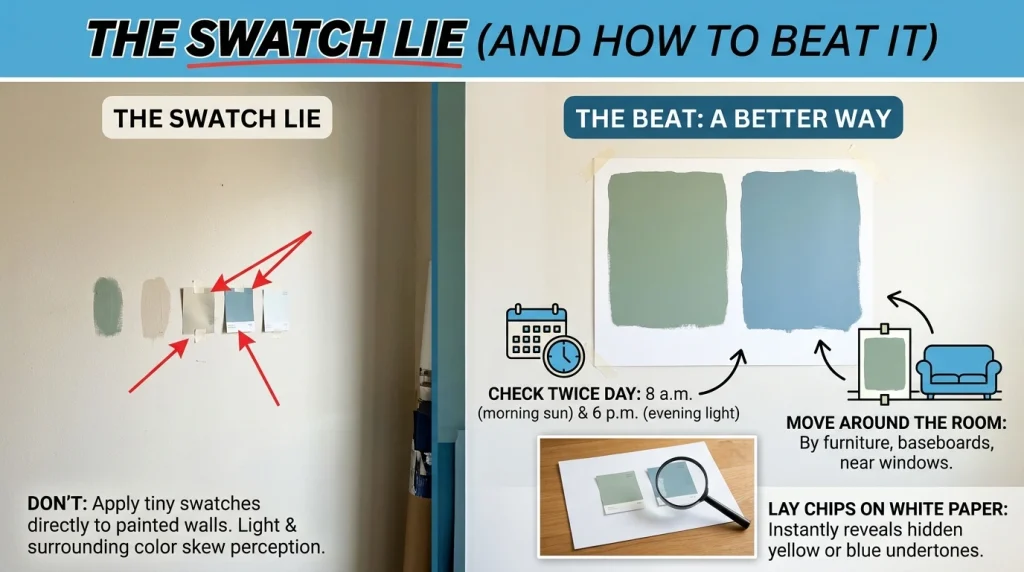
Paint a small swatch on your wall, and you’ll learn almost nothing. Your existing wall color bleeds into your perception, and the light shifts from morning to evening anyway.
Do this instead. Grab a large piece of white poster board, paint two coats on it, and move it around the room. Tape it above the skirting board. Lean it against the couch. Check it at 8 a.m. and again at 6 p.m. The undertone will reveal itself in a way a paper chip never does.
And lay your shortlist on plain white printer paper. The yellow or blue hiding inside each shade jumps out instantly. Cheapest design trick there is.
Which Whites Are Most Forgiving?

Warm whites and off-whites hide everyday marks best. Their soft undertones blur dust and light smudges. Cool and true whites do the opposite high contrast means every mark announces itself.
A few things worth knowing before you buy:
- Finish matters as much as shade. Matte finishes conceal wall imperfections well, but they can be marked easily.
- Eggshell and low-sheen are the practical middle ground for hallways and family rooms.
- Sample pots are cheap. Repainting isn’t. Buy three samples instead of guessing once.
- Check your fixed finishes first. Flooring, benchtops, and cabinetry all throw color onto your walls. A white that looks perfect in the store can clash with a warm oak floor.
Quick Answers to Common Questions
What are the three main types of white paint?
Warm, cool, and true white. Off-white is usually treated as a fourth because it sits between white and cream.
Which white paint is most popular in Australia?
Dulux Natural White, closely followed by Antique White U.S.A. and Lexicon Quarter.
Does white paint make a room look bigger?
Yes—especially cool and true whites, which bounce more light around. Just watch the undertone in north-facing rooms.
Why does my white wall look yellow?
Either warm undertones reacting to warm evening light, or a buildup of cooking grease and dust film. Clean a small patch before you panic.
What’s the difference between white and off-white paint?
Off-white has a touch more pigment, so it reads softer and slightly muted. Pure white is cleaner and higher contrast.
The Honest Takeaway
Choosing among white paint color types isn’t about finding the “best” white. There isn’t one. It’s about matching undertone to light.
Go warm or off-white if your rooms are dark or your house is busy. Go cool or true white if you have light to spare and don’t mind a bit of upkeep. Read the LRV. Test on poster board, not the wall. And never trust a swatch under fluorescent store lighting.
Browse our full range of white and off-white paint colors to compare shades side by side, or start with our most-loved warm whites if you’re still deciding.